A Visual Guide to Black Squirrels: Identifying Different Types and Colors
- July 20, 2025
- by
- John Miller
You saw one! A beautiful, mysterious black squirrel darted across the lawn, and you managed to get a good look. But as you watched, you noticed something interesting. Maybe its tail had a distinct reddish glow in the sun, or its face had little hints of white. Suddenly, you realize “black squirrel” might not be the whole story.
Welcome to the surprisingly diverse world of black squirrels! They aren’t all cut from the same cloth, and once you know what to look for, you’ll start noticing the subtle and fascinating differences between them.
In this visual guide, we’ll turn you into a black squirrel expert. We’ll show you the different species that can be black, break down the common color variations you might see in the wild, and explain what those little details can tell you about the squirrel you’ve just spotted.
The Foundation: Not All Black Squirrels Are the Same Species
First things first, the “black squirrel” isn’t a single species. In North America, it’s almost always a black color variant—known as a melanistic morph—of one of two very common squirrel species.
The Eastern Gray Squirrel (Melanistic)
This is the most common type of black squirrel you’ll find. As we discussed in our article on their rarity and origin, this is the exact same species as the everyday grey squirrel, just with a gene that produces black fur.
- How to Spot Them: They are generally smaller, with a sleeker, more slender body. Their fur is often a deep, uniform jet black, and their tail is typically long and feathery. Think of them as the “sports car” version.
The Fox Squirrel (Melanistic)
The other main player is the Fox Squirrel. They are also known to have a melanistic phase, though it’s often less common than in Eastern Grays.
- How to Spot Them: These are the “heavy-duty trucks” of the squirrel world. They are noticeably larger and stockier than gray squirrels, with a blockier head. Even when they’re black, their fur can look coarser or more grizzled.
![A larger, more robust-looking black squirrel on the ground, perhaps appearing stockier than the gray squirrel.]](https://squirrelsinfo.com/wp-content/uploads/2025/07/A-larger-more-robust-looking-black-squirrel-on-the-ground-perhaps-appearing-stockier-than-the-gray-squirrel-300x300.png)
Look Closer: A Guide to Common Color Variations
Now for the fun part. The variations in fur and color are where identification gets really interesting.
The Classic Jet Black
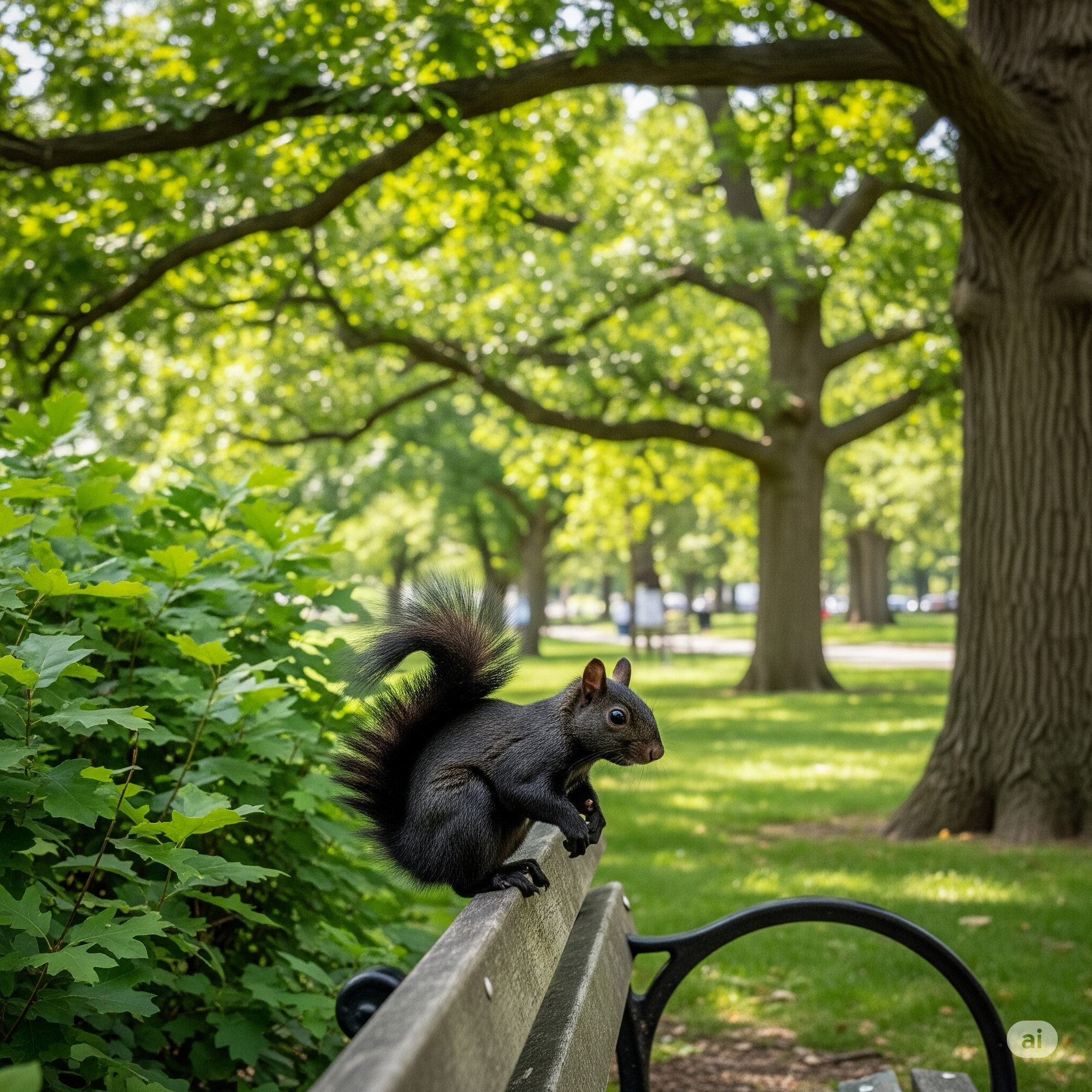
This is the quintessential black squirrel—a deep, glossy, uniform black from its nose to the tip of its tail. This look is most common in the melanistic Eastern Gray Squirrel and is a truly striking sight.
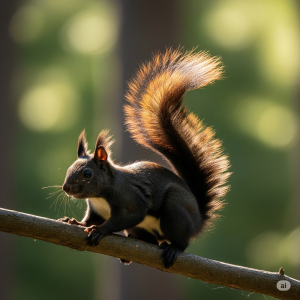
The Black Squirrel with a Red or Brown Tail
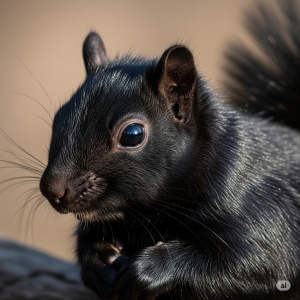
This is a very common and beautiful variation, especially in melanistic Fox Squirrels. The squirrel’s body will be mostly or entirely black, but its tail will have very distinct cinnamon, rust-red, or brownish highlights that really glow in the sunlight. Their feet and ears might also carry this brownish tint. The mix of dark and light colors is one reason they are central to so many interesting spiritual interpretations.
The “Salt-and-Pepper” or Frosted Black Squirrel
Sometimes, a black squirrel isn’t perfectly black. It may have individual white or silver-tipped hairs mixed in with its dark coat. This gives it a “frosted” or “salt-and-pepper” appearance, especially on its back and tail. This can occur in both species.
![A close-up shot focusing on the squirrel's back, where the silver-tipped hairs are visible.]](https://squirrelsinfo.com/wp-content/uploads/2025/07/A-close-up-shot-focusing-on-the-squirrels-back-where-the-silver-tipped-hairs-are-visible-300x300.png)
The Black and White Squirrel (Piebald)
Seeing one of these is a truly rare treat. A piebald squirrel has random, unpigmented white patches on its otherwise black coat. This isn’t a separate species but a genetic condition. You might see one with four white paws (as if it’s wearing socks), a white-tipped tail, or a distinct white splotch on its back. Because this is a separate and much rarer genetic trait, their unique look makes them stand out even more than a typical black squirrel.
![A photo of a black squirrel with a clear white patch, white tail, or white paws.]](https://squirrelsinfo.com/wp-content/uploads/2025/07/A-photo-of-a-black-squirrel-with-a-clear-white-patch-white-tail-or-white-paws-300x300.png)
Conclusion: Become a Squirrel Detective
The term “black squirrel” is just the beginning of the story. The real fun starts when you learn to notice the details—the stocky build of a Fox Squirrel, the reddish gleam in its tail, or the rare white patch of a piebald. The next time you’re lucky enough to spot one, take a moment to be a squirrel detective. Every one of these details tells a part of that individual animal’s unique genetic story.
Frequently Asked Questions (FAQs)
A1: A true piebald black squirrel, one with significant random white patches, is much rarer than a standard all-black squirrel. The genetic mutation for piebaldism is less common than the one for melanism, making these black-and-white squirrels a very special sight.
A2: Yes, absolutely. It’s classified as a black squirrel, and it’s most often a melanistic Fox Squirrel. The gene for melanism affects the fur on the body most strongly, while the tail sometimes retains some of the original reddish or brownish pigment.
A3: In North America, the term “giant black squirrel” usually just refers to a particularly large melanistic Fox Squirrel, as they are naturally bigger and heavier than Gray Squirrels. True “Giant Squirrels” are species native to Asia and are not found wild in the Americas.
You’ve now learned about their origins, where to find them, their behavior, their spiritual meaning, and how to identify them. To see how all this information comes together, explore our Ultimate Guide to the Black Squirrel